Thursday, May 2, 2013


Crossing the ‘Red Line’
 A recent Foreign Policy article by Aaron David Miller describes President Obama’s current Syria dilemma perfectly – damned if he does, damned if he doesn’t. Recent reports describe that there is some evidence that Assad has in fact used chemicals weapons on his people. This, as some may remember, represents a “red line”, that if crossed, would result in serious US action in Syria. Well, serious thought about action in Syria. President Obama announced that if the Syrian regime used chemical weapons on its own people, then he would be forced to change his policy towards Syria. Now that reports confirm this has indeed happened, President Obama is in a difficult place. If the US does not act, we may seem weak or encourage further use of chemical weapons by the regime. If the US does act, there is a whole list of possible options with an even larger list of possible side effects, many negative.

So what are the US options now that Assad has crossed the red line? Establishing a no-fly zone is one feasible option. The United States and NATO allies did this successfully in Libya and it could be done again. The advantages of this would be to even the playing field and give rebels on the ground relief from Assad’s air support. This may, however, be more difficult to do than it was in Libya. Assad’s anti-air batteries would have to be removed either by bombing runs or by inserting tactical teams to destroy them. We would then have to enforce the no fly zone with US or NATO air power. To do this we would need a base of operations that would probably need to be in one of the countries neighboring Syria or we could launch these attacks from aircraft carriers in the Mediterranean or the Persian Gulf. Operating out of neighboring state might prove difficult because many are reluctant to allow US forces to set up shop in their territory and states like Turkey were not all that cooperative during the second Gulf War and US forces are currently trying to get out of Iraq. This makes a no-fly zone in Syria a more complex task than it would seem on the surface. Another option is to set up safe-zones for civilians but this too requires eliminating Assad’s air forces with a no-fly zone first and then enforcing the safe-zones with peacekeepers. Arming the rebels is another option on the table but given the current divisions within the opposition movement, it may be difficult to prevent weapons from getting into the hands of some of the more extremist factions, like al-Nusra, who have links to al Qaeda. A full-scale military intervention proves even more difficult and could be a political disaster given the public’s current stance on military intervention after two unpopular and costly wars in Iraq and Afghanistan.
While these options are all on the table and could possibly manifest within the next several months, many in Washington are still uncertain whether the US should rush to intervene in the conflict. In a recent Foreign Policy article by Jeffrey Lewis, the author points out that there is still not enough evidence that Assad has used chemical weapons to warrant a US military intervention. Lewis also notes that it is unclear if whoever comes to power after the regime falls will be any better than Assad, not because Assad is great, but because the divisions within the opposition make it entirely likely that an unfriendly government will take power in Syria post-Assad. Lewis also discusses how there is a great deal of literature that suggests durable democratic systems rarely thrive after violent conflict with practically no evidence to suggest that one can “drop democratic processes on a country by JDAM” (Lewis).


Policymakers should be hesitant to get involved in a messy civil war because of still shaky evidence of chemical weapon use. Before the US escalates its Syria policy, we need more hard evidence. While there is legitimate concern that Assad has or will use chemical weapons on his people, who’s to say he won’t escalate this if the US were to escalate their policy. The chemical weapons also represent a dilemma for the US because if the Assad regime were to fall, these weapons would likely fall into the wrong hands, namely, terrorist groups who would not be as hesitant to use them. The US should evaluate the evidence closely and determine policy from there without rushing into one of the options listed above that could lead to unintended and negative consequences. The US options above could very well lead to the fall of Assad and the victory of the opposition but is it unclear who would take power and what the new government would look like. Implementing a no-fly zone or any of the other policy options is feasible, but could result in further escalation of the conflict and may lead to another state-building mission like we saw in Iraq and Afghanistan. One of the most important lessons from those cases is that problems facing a country do not end with the regime. In fact, they may only begin with the fall of the regime and get worse in the following year. The US should not rush into a military intervention in Syria without first knowing ALL the facts (see: Iraq). Overall, Obama’s declaration of the “Red Line” has left some in Washington asking, “What was he thinking?”


Sources:


A Discourse on the Syrian Conflict: Possible Responses to Assad's Alleged Use of Chemical Weapons


Violence near Turkey-Syria border as Syrian refugees try to illegally cross the border

The United States government is still investigating details about the supposed use of chemical weapons by the Syrian government against the rebellion movement. US Defense secretary Chuck Hagel confirmed this on Monday. The US government released a statement last week indicating the the Syrian government has likely used chemical weapons against the rebels on two separate occasions. It is unclear at this time how severe these attacks were. Congress’ calls for proactive measures - e.g. declaring a no-flyzone - have become increasingly louder over the course of the week.
President Obama declared that the Syrian government would cross a red line by resorting to the use of chemical weapons against its own civilians. Hagel, however, was reluctant to discuss any questions about a possible military intervention as the investigation surrounding the recent events is ongoing.
Meanwhile, preventative measures have been taken at a Turkish hospital located near the Turkey-Syria border for the treatment of Syrians injured in the attacks. It was reported that dozens of Syrian rebellions may have been injured in an attack involving chemical weapons, as was confirmed from sources from inside the Turkish hospital on Tuesday.
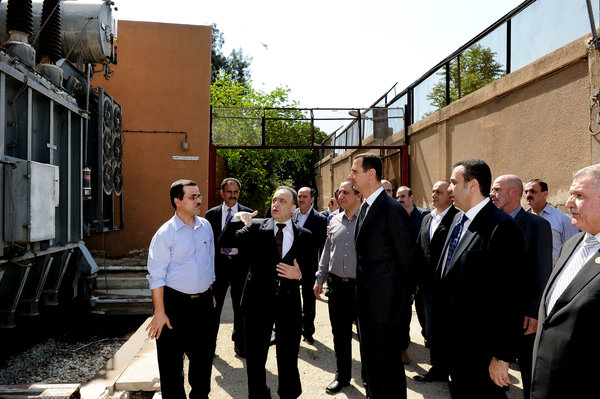
Assad during a rare public appearance
The use of chemical weapons is considered to be crossing a red line in the international political community. Though there is no conclusive evidence of such warfare tactics occurring in Syria, the possibility and accusations elevates the situation to a new level. The international political community, NATO, and the US in particular, have various options to consider in their efforts to aid the people of Syria. 
One, is military action and sending forces to Syria. Obama issued a warning to Assad last August, stating that if he resorted to the use of chemical weapons - or preparing them for use - that would be considered crossing a red line with “enormous consequences”. Prior to that, Obama made the statement that Assad’s government would be held accountable. 
Another possibility is for the US to increase their support for the opposition movement. So far, the US has supported the rebels with non-lethal aid. Recently, the Obama administration announced that they would continue and increase their support - up to $250 million worth of assistance. While the supply of arms is one of the various options currently in consideration, that option is to be refrained from until there is conclusive evidence of the use of chemical weapons in Syria. The careful selection and supplying the rebels with arms would greatly increase the movement’s appeal in Syria and its effectiveness in their struggle against the authoritarian regime under Assad.
Lastly, NATO needs to consider its role in the Syrian conflict and assess their capabilities and preparation for a possible intervention. The US secretary of state has urged NATO to consider how they are prepared to respond to threats by Syria. Thusfar, NATO has expressed of having no intention to using military intervention in the Syrian conflict. Though there is concern for a possible regional threat to some of its 28 member states, NATO maintains that they will not intervene militarily. If conclusive evidence shows that Assad has in fact used chemical weapons against Syrians, however, NATO and the US government will have to take preventative action to protect its member states and hold firm on their outward political values.
The situation remains uncertain while the investigation is ongoing, but it appears that an intervention by the international community is imminent. The Syrian civil war is an ongoing conflict lasting over 2 years at this time and recent escalations are troublesome. It is recommended that the international community watch closely as the conflict continues and take measures to protect the people of Syria and aid them in their mission to establish an appropriately representative government regime.

Lin Nouheid, Alex Warren. "The Battle for the Arab Spring"
Al Jazeera. “Gauging Hezbollah’s role in Syria” <http://www.aljazeera.com/programmes/insidestory/2013/05/20135262433130722.html>
CNN. “For Syria, chemical weapons also a ‘red line, information minister says” <http://www.cnn.com/2013/05/02/world/meast/syria-civil-war/index.html>
New York Times. “Israel Says It Has Proof That Syria Used Chemical Weapons”. <http://www.nytimes.com/2013/04/24/world/middleeast/israel-says-syria-has-used-chemical-weapons.html?pagewanted=all&_r=0


Deutsche Welle. "NATO worried about Syrian chemical weapons"
<http://www.dw.de/nato-worried-about-syrian-chemical-weapons/a-16766049>

Al Jazeera. “US urges NATO to consider role in Syria” <http://www.aljazeera.com/news/middleeast/2013/04/2013423133258432886.html

Wednesday, May 1, 2013

Economic Turmoil in Tunisia


In early March, a cigarette vendor named Adel Khazri set himself on fire in the capital, Tunis, an act reminiscent of Mohamed Bouazizi’s self-immolation that triggered the beginning of the Jasmine Revolution. He was protesting the high level of unemployment in the country. Overall unemployment is currently 17%, with levels as high as 30% in rural areas (F.T., 2013).

The struggling economy remains the focus of Tunisia’s civil unrest. Despite current changes regarding women’s rights and the reemergence of the Salafist movement, high unemployment and rising debt are the focus of international attention. Many blame “tunisia’s tax code [that] favours exporting companies. Those that sell locally face higher tariffs and more regulation”(F.T., 2013). This creates a dynamic where exports are encouraged rather than investment, trade, and capital flow within the country’s borders. Similar to this globally-focused economic dynamic, many believe that economic policy has been formed in favor of the global market rather than for the benefit of the country, and hope that “economic policy will be written for the Mohammed Bouazizis of the world rather than the bankers” (Ryan, 2013).
The 2013 WSF was located in Tunis.

Another aspect of the current economic turmoil in Tunisia is the “looted assets”(Reuters, 2013) from Ben Ali’s rule; recently Tunisia received a check for $28.8 million dollars, retrieved from a Lebanese bank account held by Leila Trabelsi, former president Zein al-Abidine Ben Ali’s wife. This is the result of a appointed UN representative’s efforts to recover stolen assets; billions remain missing.

Both the International Monetary Fund (IMF) and World Social Forum (WSF) are currently playing roles in the country regarding rehabilitation of the economy and next steps for Tunisia’s government. Tunisia is currently negotiating a $1.78 billion dollar loan from the IMF in order to keep the economy afloat. However, the way in which the IMF is pushing economic reform could undermine the public’s confidence in the democratic transition of the government if the new policies are pushed through without the debate and approval of the country’s elected officials.

In terms of political stability, a reemergence of a "Bourguibist" tradition has been predicted, based upon the rule of Ben Ali’s predecessor, Habib Bourguiba, who was deposed in 1987. Currently, the government is attempting to retain legitimacy in the democratic transition by including more parties; the Prime Minister, Ali Laarayedh, ceded key ministries to non-party figures in response to the assassination of leftist politician Chokri Belaid on February 6th of this year (E.B., 2013).

Demonstration at the World Social Forum in Tunisia
Focusing upon the economic instability of the country and ways in which economic policy can reflect negatively upon the democratic transition of Tunisia is important when considering the future of the country. As a “homegrown” revolution originally, Tunisia may face further and increased uprisings if the public does not feel that anything has changed. Based on Tunisia’s past experiences and the current social climate, it seems that future demonstrations will continue to be largely nonviolent. The protests will most likely also continue to include the most affected parties, which are the younger college-graduate part of the population, that is highly educated and in dire need of opportunities.

Tunisian Flag
The public will need to see improvement in job opportunities and over all unemployment rates, as well as accountability and transparency within the government that indicate a successful democratic transition. I would recommend that the government wait until the legislative and presidential elections later this year to make decisions concerning the IMF loan, so that the process is facilitated by elected officials rather than representatives from the IMF. I would also recommend that the government pay particular attention to changing cultural and social factors; the backlash from the states previous restraint of Muslim practices and religious parties and the growing ambiguity of women’s rights will be important changes that could affect economic and political issues as the cultural climate of Tunisia changes. For now, it seems we will have to wait for the elections this fall to see what Tunisia does with this rare opportunity to redefine itself.

Works Cited:

E.B. “Macbeth in Tunis: Fair is foul and foul is fair.” The Economist. 25 March 2013. <http://www.economist.com/blogs/pomegranate/2013/03/macbeth-tunis>

F. T. “Tunisia’s economy: Still struggling.” The Economist. 19 March 2013. <http://www.economist.com/blogs/pomegranate/2013/03/tunisias-economy>

Reuters. “Tunisia: Millions recovered from ex-leader’s assets.” The New York Times. 11 April 2013. <http://www.nytimes.com/2013/04/12/world/africa/tunisia-millions-recovered-from-ex-leaders-assets.html>

Ryan, Yasmine. “Tunisia World Social Forum to blast austerity.” Al Jazeera. 26 March 2013. <http://www.aljazeera.com/indepth/features/2013/03/201332653645288688.html>


Monday, April 29, 2013

Failure to Launch

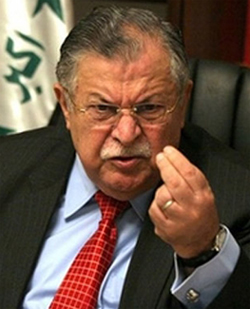
President Jalal Talabani
2013 has proved to be a rough start for Iraq thus far.  Sectarian animosities are still present, however, they are starting to take new form.  They are now playing out without some of the players that were once very influential in enforcing the rules.  While the majority of Iraqis grew very tired of U.S. presence, the reality was that the U.S. was the only actor capable of bridging sectarian divisions before they spiraled into violence.  Now with the U.S. gone, and President Jalal Talabani’s heath decreasing, charges of political dominance and sectarian discrimination among Prime Minister Nuri al-Maliki’s opponents have left most wondering if Iraq is about to face the year’s first open confrontation.  
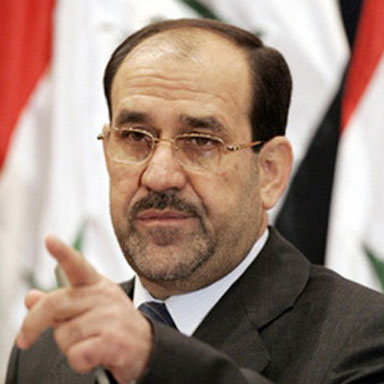
Prime Minister Nuri al-Maliki

A few months ago, Iraqi police invaded the Finance Ministry 
Rafa al-Issawi
building and detained around 150 bodyguards who worked 
for Rafa al-Issawi, the chief minister for financial affairs and 
one of the government’s top Sunni officials.  Shortly after, 
news broke out that the Shia led government was targeting 
the staff of a top Sunni politician.  Upon hearing this, 
thousands of Iraqis from the Sunni heartland flocked 
to the streets in protest.  These were so large that 
the major highway connecting Baghdad to Jordan 
and Syria was completely shut down.

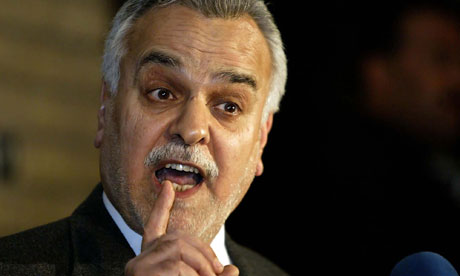
Vice President Tariq al-Hashimi
This, however, wasn’t anything new for the Sunni population.  Last year, they experienced something similar to this when Iraqi security forces arrested several guards who worked for the Vice President Tariq al-Hashimi.  After the confession of plotting terrorist attacks, Hashimi fled the country to Turkey in order to avoid the death sentence.  Whether or not he was actually guilty is irrelevant, though.  What is important is that a huge majority of the Sunni population viewed these arrests as a carefully planned vendetta by a Shia led premier against the Sunni rival.  The marginalization and alienation felt by the Sunni’s when Saddam Hussein was overthrown was now being relived and reinforced.

In the past, the U.S. and President Talabani were able to suppress those feelings until that current crisis needed intervention.  With the U.S. no longer present and Talabani recovering from his stroke in a German hospital, Iraq must find someone who can perform this difficult task.  I think in an ideal world, al-Maliki would fill the spot himself, however, with protests continuing and the prime minister reluctant to back down, it is quite unlikely this will actually happen.


Tunisia-A bright future, or a return to the past?


      In recent months, we have seen tremendous strides made in Tunisia for equality and freedom. Just last month, tens of thousands of activists from around the globe converged on Tunisia for the World Social Forum, the "annual counter-hegemonic meet where opponents of neo-liberalism, free trade and austerity rally together".


       The slogan of this year's forum, which ran from March 26th to 30th, in keeping with the spirit of Tunisia's January 2011 uprising, was dignity. After all, the Jasmine Revolution began only after Mohamed Bouazizi, a 26-year old Tunisian street vendor, set himself afire on December 17th 2010, in protest of the confiscation of his wares and the humiliation that was inflicted on him by a municipal official. All Mohamed wanted was dignity, and his cries for it can still be heard across Tunisia, echoed by most of the countries citizens.  Most Tunisians describe their uprising as a struggle for dignity – the term "Jasmine Revolution" was only ever used by foreign journalists. They have been demanding affordable basic necessities, the right to employment and to a more just and equitable society. 


   Romdhane Ben Amor, a spokesperson for the WSF organising team, told Al Jazeera that organisers had initially hoped to hold the event in Egypt, but had opted for Tunisia due to its comparative stability.


It's the first time the forum was held in an Arab country.


   The issue of public debt was one of the main topics on the forum's agenda."It's a leading dilemma in Tunisia," said Ben Amor. "There's no work, prices are rising, the government isn't able to invest in society, and it's all because of the debt."

       According to Al Jazeera, "Tunisia is currently negotiating a $1.78 billion dollar loan from the IMF to help keep its economy afloat, and the newly-formed government may sign the agreement this month. Yet the reforms the IMF is pushing the government to accept would, according to some economists, make life even harder for a population that so recently rose up in revolt over economic misery." We can only hope that this is not the case, especially after the tremendous strides Tunisia has made as a nation in recent months. 


    It is estimated as many as 50,000 visitors from 128 countries gathered at the World Social Forum to discuss shared economic and social problems. The forum began with all these participants marching down the streets of Tunis, the capital. For the Tunisian citizens who attended, I am sure there was a feeling of dejavu from when their protests initially began several years ago. However, this time they were marching in a different Tunisia, a changed Tunisia. 

     The debt has not kept Tunisia from making great strides in efforts to promote freedom and equality. Just last week, guarded by armed Tunisian police, Jewish revelers chanted and danced in a three-day pilgrimage to the El Ghriba synagogue, the oldest synagogue in Africa, located on an island resort 500 kilometers south of Tunis.

Jewish men pray inside the blue-tiled El Ghriba synagogue on the Tunisian island of Djerba following a wedding ceremony May 10, 2012. REUTERS/Anis Mili


       In 2011, after the uprising that toppled former president Zine El Abidine Ben Ali, the annual celebration was canceled. In 2002 militants linked to al Qaeda attacked the synagogue with a truck bomb killing 21 Western tourists. In 2012 only a few dozen Jews attended out of fear of possible attacks by hard line Islamists.


Security for this year's pilgrimage was tight, with hundreds of police on duty.
   "The strong presence of security is a positive step and sends a message to the Jews in the world that Tunisia protects us even if its leaders are Islamists", Perez Trabelsi, the head of the Jewish community in Djerba, told Reuters.com

       Hosting both the World Social Forum, as well as offering high levels of police protection for an ancient Jewish pilgrimage? This does not sound like the Tunisia we know and have learned about in class.  So we must ask ourselves, have we truly seen progress in Tunisia? Is the Tunisia we see now different from the Tunisia of a year ago? Two years ago? Or even of 10 years ago? It is hard to argue that Tunisia has not changed. Hosting the World Social Forum and the recent return of an ancient Jewish pilgrimage under military protection seem far from possible under the regime of Ben Ali. Perhaps Tunisia has yet to reach its goals of dignity for all, but the country where the Arab Spring started is setting a wonderful example for it's neighboring countries to follow. 


Tunisians protest outside the gates of the French Embassy after remarks made by the French ambassador that were perceived as insulting. Such a public display of expression by Tunisians would have been unheard of during the Ben Ali reign.

    This is not the Tunisia we have learned about in class. It is a new Tunisia; one striding for freedom, equality, and of course, dignity. It is nearly impossible to say Tunisia has not changed, and is not continuing to change and transform from the country it once was to a more democratic nation. Prior to the revolution, Tunisia was plagued by government censorship, a lack of civic life, corruption, and vast human rights violations. Since the revolution, non-governmental organizations have reconstituted themselves and hundreds of new ones have emerged. For instance, the Tunisian Human Rights League, the first human rights organization in Africa and the Arab world, which operated under restrictions and state intrusion for over half of its existence, is now completely free to operate. 

    Tunisia is a shining beacon of future possibilities in an area of the world ravaged by war and revolution. Tunisia has proven that through the chaos, we can find peace and new democratic ideals. Although Tunisia still faces tremendous debt as well as other more complicated social issues, if the nation continues in the direction it is currently moving, we can only expect to see a once corrupt,authoritarian state, become a budding democracy and a role model for other nations within the Middle East and North Africa.

Works Cited:

Amara, Tarek, "Jews revive annual pilgrimage to Africa's oldest synagogue", Reuters.com, http://www.reuters.com/article/2013/04/27/us-tunisia-jews-idUSBRE93Q07L20130427, last updated Saturday April 27th, 2013

Yasmine, Ryan, "Tunisia World Social Forum to blast austerity", Aljazeera.com, http://www.aljazeera.com/indepth/features/2013/03/201332653645288688.html, last updated March 26th, 2013


More Protesters Apprehended by Police in Bahrain


Bahrain remains in full of protests and riots, as the government tries to crack down they have taken many new suspects into custody.


Protesters wave Bahraini flags during an anti-government demonstration in the village of Diraz, west of Manama, late on April 27, 2013 (AFP Photo / Mohammed Al-Shaikh)
       It was announced this past weekend that police have arrested 22 suspects who have allegedly been part of the civil protests and unrest within Bahrain. Some have been accused of participating in what the Bahraini police are calling, a terrorist attack, police forces in a small village outside of Manama as that took place on March 7th. Others are being arrested for their part in the Formula One Riots that just recently took place. Still some are being arrested on charges of blockading roads and burning tires. The majority of the suspects were picked up in Shiite neighborhoods.  It is estimated by human rights groups that since the start of these demonstrations in 2011, at least 80 people have been killed and thousands arrested.

       This comes after the indefinite postponement of the UN torture reporter Mr. Juan Mendez meeting in Bahrain. The cancellation was a unilateral decision made by Bahraini officials. This event had been in the making for a year and a half yet after recent events, Bahrain was not willing to oblige.
            
     As these two stories come out within a week of each other, the cancelled visit impacts the way we view the new suspects, that have been apprehended. Is this something the UN should be watching more closely? With this meeting cancelled does this imply Bahrain is using various methods of torture and not willing to stop? That is what it seems like to me, while there isn’t any hard evidence the connections seem too strong. As we have discussed in class due to the threat felt by the regime, they are more likely to use repression to try and control their population, torture is part of that.

Sources
http://www.nytimes.com/2013/04/25/world/middleeast/un-expert-says-bahrain-canceled-visit-in-torture-inquiry.html?ref=bahrain&_r=0
http://www.vob.org/en/index.php?show=news&action=article&id=2238

Elections without the US

April 20th, 2013 was the first Iraqi election without security help from the US. This election replaced 18 local councils elected in 2009 with 18 new governorates. The campaign for this 2013 election has been violent but not as violent as many thought it would be. Leading up to the election there were 14 candidates killed.  The Iraqi government implemented many security measures leading up to the elections in order to keep citizens and candidates safe. These measures included a car ban and a curfew on Election Day. Three providences, Anbar, Kirkuk and Nineveh, did not hold elections because of insecurity in the region. The security measures produced a major problem with the elections, by making the polling centers very difficult to get to. Many Iraqis claimed that the voting centers were too far away without the use of cars and therefore they were not able to vote in this election.


The violence leading up to this election has been the same violence that has overcome Iraq and the Middle East; racial disputes between the Sunni’s and Shiites. The fourteen candidates that have been killed in this election were all Sunni. It is reported that some assassinations were by political opposition but others were by Sunni radicals associated with Al Qaeda. It may seem odd that radical Sunnis would attack other Sunnis when they want more representation I the Shiite controlled government, but the targets have been more moderate Sunnis that look to work with the Shiites for equality. The deterrence of voters due to curfew and car bans is not the reason people are not appearing at the polls to vote. The problem is fear. The violence between the Sunnis and Shiites is deterring both voters and viable candidates.


A political science professor at a Bagdad university explains, “Killing candidates means instilling fear and that is why I think it will affect voter participation, because I don’t think people will want to risk their lives again.” Many believed that the violence leading up to this election was mild compared to what it could have been. However, next year Iraq will hold general elections for the first time without US security forces. This is the main concern in Iraq right now. If this amount of fear is being provoked for eighteen local councils, what will happen in a general election in Iraq?

Sources: